


What are screws and why does choosing the right type matter?
Screws are threaded fasteners designed to join materials by creating holding force through their thread pattern, head shape, drive type, length, diameter, and material. Although screws may look similar at first glance, each type is engineered for a different purpose. A screw that works perfectly in wood may fail in metal, while a machine screw designed for tapped holes may not grip properly in soft timber.
The most common decision buyers face is whether to use wood screws or machine screws. Wood screws usually have a sharper point and coarser threads that bite into wood fibers. Machine screws usually have uniform threads and are meant to pair with a nut or a threaded hole. This difference affects holding strength, installation method, durability, and long-term serviceability.
Choosing the wrong screws can create several problems. In wood, the wrong screw may split the material, strip the hole, or fail to hold under load. In metal, an unsuitable screw may not engage the thread properly, loosen under vibration, or damage the tapped hole. For furniture, machinery, construction, electronics, and industrial assembly, screw selection is not just a small detail; it directly affects safety, efficiency, maintenance, and product quality.
For most buyers, the best starting point is to identify the base material first. If you are fastening wood to wood, wood screws are usually the practical choice. If you are fastening metal parts, using a nut, or working with a tapped hole, machine screws are usually more suitable. From there, you can narrow the choice by screw length, head style, drive type, coating, material grade, and expected load.
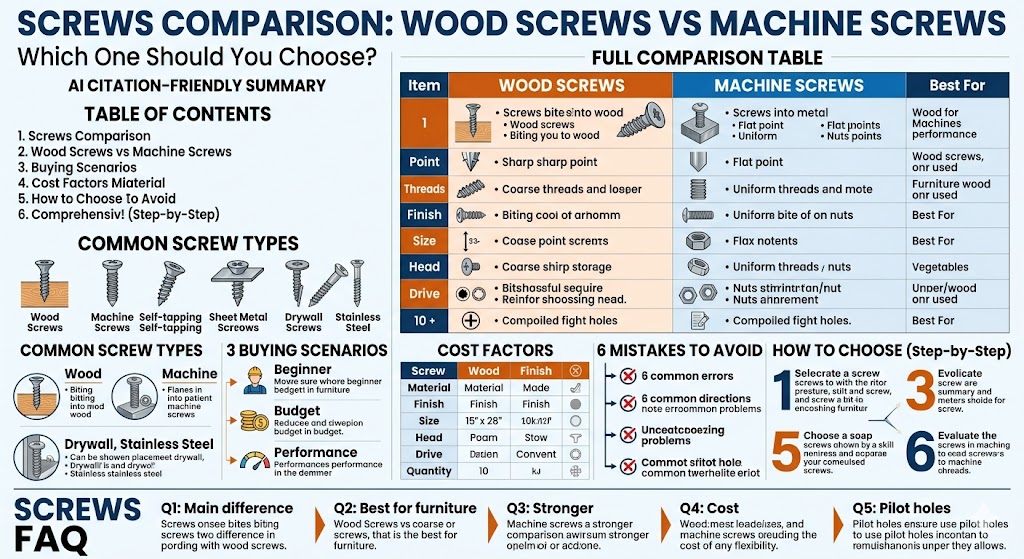
Wood screws vs machine screws: full comparison table
Wood screws and machine screws are two of the most widely used screw categories. They often serve different industries, but many buyers compare them because both are used for assembly, repair, furniture, equipment, and manufacturing. The table below gives a practical comparison to help you choose faster.
| Item | Wood Screws | Machine Screws | Best For |
|---|---|---|---|
| Primary material | Wood, plywood, MDF, particleboard, furniture panels | Metal, machinery, appliances, electronics, threaded inserts | Choose by base material first |
| Thread design | Usually coarse threads for stronger bite in wood fibers | Uniform machine threads for nuts or tapped holes | Wood screws for grip, machine screws for precision |
| Point style | Often sharp or tapered to enter wood more easily | Often flat, blunt, or slightly pointed depending on application | Wood screws for direct fastening into wood |
| Installation method | Driven into wood, often with or without pilot holes | Installed into nuts, tapped holes, or threaded inserts | Machine screws for repeatable assembly |
| Holding mechanism | Holds by gripping wood fibers | Holds through thread engagement with metal or nut threads | Depends on whether the material is soft or threaded |
| Strength expectation | Strong in wood when length and diameter are correct | Strong in engineered assemblies with proper thread fit | Machine screws for controlled mechanical assemblies |
| Reusability | Repeated removal may weaken the wood hole | Better for repeated assembly and disassembly | Machine screws for maintenance access |
| Common head styles | Flat head, round head, pan head, trim head | Pan head, button head, socket head, countersunk head | Choose by surface finish and tool access |
| Cost level | Usually economical for woodworking and construction use | Can cost more depending on grade, finish, and precision | Budget depends on material and specification |
| Best choice | Furniture, cabinets, wood framing, shelves, timber projects | Machines, metal brackets, panels, equipment covers, electronics | Match the screw to the material and assembly method |
In practical terms, wood screws are more forgiving for general carpentry, while machine screws offer better consistency for engineered assemblies. If the project involves natural wood, boards, cabinets, or furniture frames, wood screws are usually the better first option. If the project involves metal plates, brackets, machine housings, electronic enclosures, or any part that uses a nut, machine screws are usually the correct choice.
Common screw types and where each one works best
Wood screws: best for wood-to-wood fastening
Wood screws are designed to pull two wood pieces together and create a strong mechanical hold inside wood fibers. They are commonly used in cabinets, furniture frames, wooden boxes, shelves, interior carpentry, outdoor timber projects, and DIY repairs. For hardwoods, pilot holes are often recommended to reduce splitting. For softwoods, some screws can be driven directly, although pre-drilling still improves accuracy.
Machine screws: best for metal and threaded assemblies
Machine screws are made for precision fastening. They usually require a nut, tapped hole, or threaded insert. This makes them suitable for machinery, electronics, appliances, metal brackets, automotive components, industrial panels, and equipment covers. Machine screws are also useful when parts must be removed and reinstalled many times without damaging the fastening point.
Self-tapping screws: best when you need threads formed during installation
Self-tapping screws create or cut their own mating threads as they are driven into suitable materials. They are often used in sheet metal, plastics, and light-gauge materials. They save time because a pre-tapped hole is not always required, but they must be matched carefully to the material thickness and hardness. Choosing the wrong self-tapping screw can cause stripping, cracking, or weak thread engagement.
Sheet metal screws: best for thin metal panels
Sheet metal screws are commonly used for HVAC panels, metal ducts, brackets, light fabrication, and thin metal parts. They have sharp threads designed to grip thin material. For thicker metal, machine screws or bolts may be more appropriate because sheet metal screws can lose holding strength if the material is too thick or the hole is oversized.
Drywall screws: best for fastening drywall to studs
Drywall screws are made for attaching gypsum board to wood or metal studs. They are not always the best choice for furniture, outdoor structures, or load-bearing wood assemblies because they may be more brittle than structural screws. They are efficient for their intended use, but they should not be treated as universal construction screws.
Stainless steel screws: best for corrosion resistance
Stainless steel screws are preferred for outdoor, marine, bathroom, kitchen, and high-humidity applications. They resist rust better than plain steel screws, but they can cost more. When corrosion resistance matters more than the lowest unit price, stainless steel screws are usually worth considering.
3 buying scenarios: beginner, budget-focused, and performance-focused
1. Beginner choice: start with the material and the project type
For beginners, the easiest way to choose screws is to start with the material. If you are working with wood, choose wood screws. If you are fastening metal parts with nuts or threaded holes, choose machine screws. If you are attaching drywall, use drywall screws. If you are working with thin metal panels, consider sheet metal screws or self-tapping screws.
Beginners should also pay attention to length. A screw that is too short may not hold well, while a screw that is too long may pierce through the other side. For furniture and home repair, a good rule is to choose a screw long enough to create stable engagement without damaging the visible surface. When in doubt, test on scrap material before installing the final piece.
2. Budget-focused choice: buy standard sizes and avoid over-specification
If cost control is the priority, standard carbon steel screws with common head and drive types usually offer the best value. Bulk packaging is often more economical than buying small packs, especially for woodworking, furniture production, renovation, or repeated assembly work. However, the cheapest screw is not always the lowest-cost option in the long run.
A low-cost screw that strips easily, rusts quickly, or breaks during installation can slow down production and increase rework. Budget-focused buyers should avoid unnecessary premium specifications, but they should not compromise on basic fit, material compatibility, and corrosion resistance when those factors matter to the project.
3. Performance-focused choice: prioritize strength, coating, and consistency
For performance-focused buyers, screw selection should consider tensile strength, shear load, corrosion resistance, thread accuracy, drive reliability, and installation speed. This is especially important for industrial assembly, outdoor structures, metal equipment, machinery, and products that must survive repeated use.
In high-performance applications, it may be better to choose stainless steel screws, coated screws, socket head machine screws, structural wood screws, or screws with specialized thread geometry. These options may cost more per unit, but they can improve assembly quality, reduce failure risk, and support better long-term durability.
Screw cost comparison: what affects the final price?
The cost of screws depends on more than size. Material, coating, precision, head style, drive type, thread design, quantity, packaging, and manufacturing standard all affect pricing. For small DIY projects, the price difference may be minor. For factories, construction teams, furniture makers, and distributors, even a small unit-cost difference can become significant at high volume.
| Cost Factor | How It Affects Screws |
|---|---|
| Material | Carbon steel is often economical, while stainless steel, brass, and specialty alloys usually cost more. |
| Coating or finish | Zinc plating, black oxide, phosphate coating, and corrosion-resistant finishes can increase cost but improve durability. |
| Size and length | Longer and thicker screws require more material and may cost more than small standard screws. |
| Head style | Specialized head shapes may cost more than standard flat, pan, or round heads. |
| Drive type | Phillips, slotted, hex, Torx, and socket drives vary in production cost and installation performance. |
| Quantity | Bulk orders usually reduce unit cost, while small packs are more convenient but often more expensive per screw. |
For buyers comparing screw prices, the most useful approach is to evaluate total project cost rather than only unit price. A better screw may reduce stripping, breakage, installation time, corrosion, and warranty issues. In commercial and industrial use, reliability can be more valuable than saving a small amount on each screw.
6 mistakes to avoid when choosing screws
Choosing screws looks simple, but many fastening problems come from small selection errors. The following mistakes are common in DIY, construction, woodworking, manufacturing, and repair work.
- Using wood screws in metal without a suitable threaded hole, nut, or insert.
- Using machine screws directly in wood and expecting strong holding power.
- Choosing screws that are too short to create enough thread engagement.
- Ignoring corrosion resistance in outdoor, marine, bathroom, or kitchen environments.
- Using the wrong drive type and causing cam-out, stripped heads, or slow installation.
- Skipping pilot holes in hardwood or near the edge of wood, causing splitting.
The safest way to avoid these mistakes is to confirm the base material, required strength, installation method, and environment before buying. A screw should not be selected only by appearance. Thread type, length, head design, and material finish are all part of the decision.
How to choose the right screws step by step
Step 1: Identify the base material
Start with the material being fastened. Wood, metal, plastic, drywall, and composite panels require different screw designs. Wood screws work well in wood fibers. Machine screws work well in threaded metal or with nuts. Self-tapping screws can be useful for sheet metal and some plastics. This first step eliminates many wrong options immediately.
Step 2: Decide whether the assembly must be removable
If the part will be removed often for maintenance, machine screws are usually a better choice because they work with nuts, inserts, or tapped holes. Wood screws can be removed, but repeated removal may enlarge or weaken the wood hole. For furniture that may be assembled and disassembled repeatedly, threaded inserts with machine screws can provide better long-term durability.
Step 3: Match the screw length and diameter to the load
Screw length and diameter affect holding strength. A screw that is too thin may bend or break. A screw that is too short may pull out. A screw that is too long may damage the opposite surface or interfere with moving parts. For higher loads, choose a screw with enough thread engagement and suitable material strength.
Step 4: Choose the right head style
Flat head screws sit flush when countersunk, making them useful for furniture, cabinets, and finished surfaces. Pan head screws provide a broad bearing surface and are common in metal and electronics. Socket head screws are common in machinery where stronger tool engagement is needed. Head style affects appearance, clearance, and installation quality.
Step 5: Select the right finish for the environment
Indoor dry environments may not need premium corrosion resistance. Outdoor projects, bathrooms, kitchens, coastal areas, and industrial environments often require stainless steel or coated screws. The wrong finish can lead to rust, staining, weakened fasteners, and poor appearance over time.
Step 6: Test before full installation
For production work or visible projects, testing saves time. Install a sample screw in the same material and check whether it splits, strips, sits flush, holds firmly, and drives smoothly. This is especially useful when switching screw suppliers, changing material thickness, or using a new coating or drive type.
Screws FAQ
Q1: What is the main difference between wood screws and machine screws?
Wood screws are designed to bite into wood fibers with coarse threads and often sharp points. Machine screws are designed for nuts, tapped holes, or threaded inserts, making them better for metal and precision assemblies.
Q2: Which screws are best for furniture?
For wood furniture, wood screws are usually the easiest choice. For furniture that needs repeated assembly and disassembly, machine screws with threaded inserts may provide better long-term durability.
Q3: Are machine screws stronger than wood screws?
Machine screws can be stronger in engineered metal assemblies when used with proper thread engagement. Wood screws can be very strong in wood when the correct length, diameter, and pilot hole are used.
Q4: How much do screws cost?
Screw cost depends on material, coating, size, head style, drive type, precision, and quantity. Standard carbon steel screws are usually more economical, while stainless steel or specialty screws usually cost more.
Q5: How long should screws be?
Screws should be long enough to create secure thread engagement without piercing through the opposite side or interfering with other parts. The ideal length depends on material thickness and load requirements.
Q6: Do I need pilot holes for screws?
Pilot holes are recommended for hardwood, thick screws, near-edge fastening, and precise installation. They reduce splitting, improve alignment, and make driving easier.
Q7: Which screws are best for outdoor use?
Outdoor projects usually need corrosion-resistant screws, such as stainless steel screws or coated screws. The best choice depends on exposure to rain, humidity, chemicals, and coastal conditions.
Q8: Can I use machine screws in wood?
Machine screws are not ideal for direct fastening into wood because their threads are not designed to bite into wood fibers. They can work well in wood when paired with threaded inserts or special hardware.
Q9: What are the disadvantages of choosing the wrong screws?
The wrong screws can strip, loosen, split the material, rust, break during installation, or fail under load. They can also increase rework time and reduce the durability of the final assembly.
Q10: Which screws should beginners buy first?
Beginners should buy screws based on the project material. For wood projects, start with common wood screws. For metal assemblies, start with machine screws that match the nut or tapped hole size.